
The AI Companion That Leaves Your Notes Alone
Sidian Sidekicks reads an existing Obsidian vault but writes its research and review into separate folders, leaving the source notes untouched.
- Project
- Sidian Sidekicks
- Role
- Product thinking, interaction design, and engineering
- Timeframe
- 2026 – present
- Status
- Live
Evidence from the work
- Artifact
- Working product
- Product boundary
- Generated work stays separate from original notes
What this is
Sidian Sidekicks brings AI agents into an existing Obsidian practice. It reads the context a person has built across notes, journals, plans, and project files. Its agents can find patterns, research an idea, or respond to a direct request.
The product remains under active development. The current experience establishes the operating boundary between a person’s writing and the material an agent produces.
The friction
Open a blank AI chat and you have to explain the context again, then carry useful output back into the place where the work belongs. Let the assistant write inside an existing knowledge base and the transfer disappears, but authorship becomes harder to see.
Obsidian users often choose local notes because they value ownership and continuity. An assistant that rewrites those notes without a clear boundary asks the user to trade that control for convenience.
The senior decision
We separated human writing from generated work.
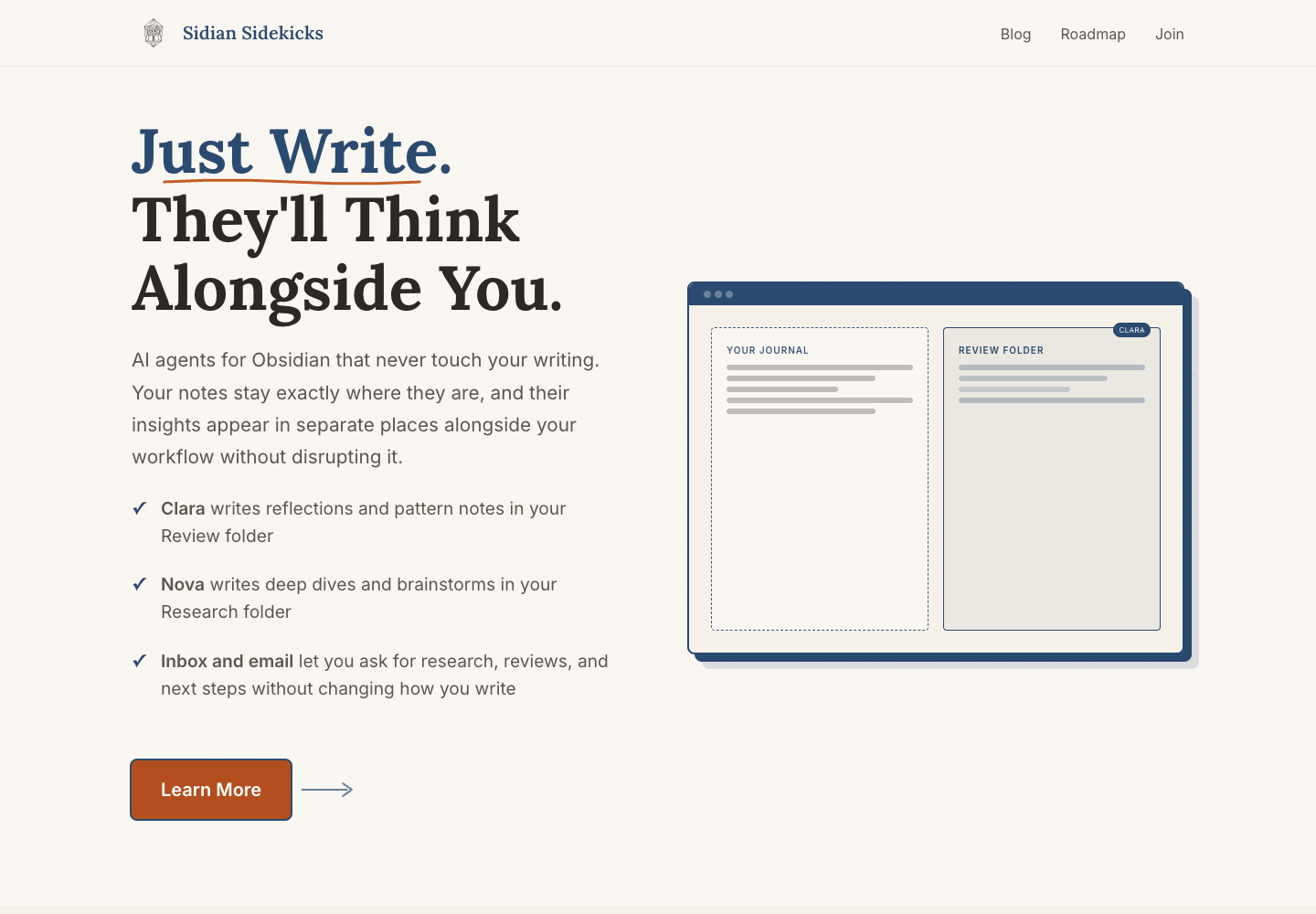
The agents read the source material but place their responses in dedicated Review and Research folders. Clara can identify recurring themes and questions. Nova can expand an idea with outside research. Neither agent edits the source note to make its contribution look native.
This decision adds a review step and gives the user a stable rule: original notes remain theirs. Generated material stays visible, attributable, and disposable.
The product follows that same restraint in its delivery. A daily digest can bring useful observations forward without requiring another dashboard to monitor throughout the day.
What became real
Sidian Sidekicks now has distinct agent roles, an inbox for direct requests, separate output locations, and a digest that collects useful observations.
The folder boundary shapes more than file placement. It determines how agents ask for attention, how users review their work, and how the product protects quiet writing from automated intervention.
Evidence
The working product is available at sidiansidekicks.com. Its product interface and public explanation show the separate roles for the agents and the distinction between source notes and generated output.
The evidence supports the implemented workflow and the boundary a user can inspect. We do not yet have enough use over time to make retention or productivity claims.
What we learned
AI products need an ownership model for generated material. File placement, labels, and review states establish that model inside the workflow, before explanatory copy has to repair confusion.
An assistant earns trust through limits as much as capability. Sidian Sidekicks makes one limit concrete: the assistant can read your writing, but it does not get to impersonate you inside it.
Current state
The product and its core separation model are live. Agent behavior, delivery rhythm, and the wider experience continue to evolve through use.