

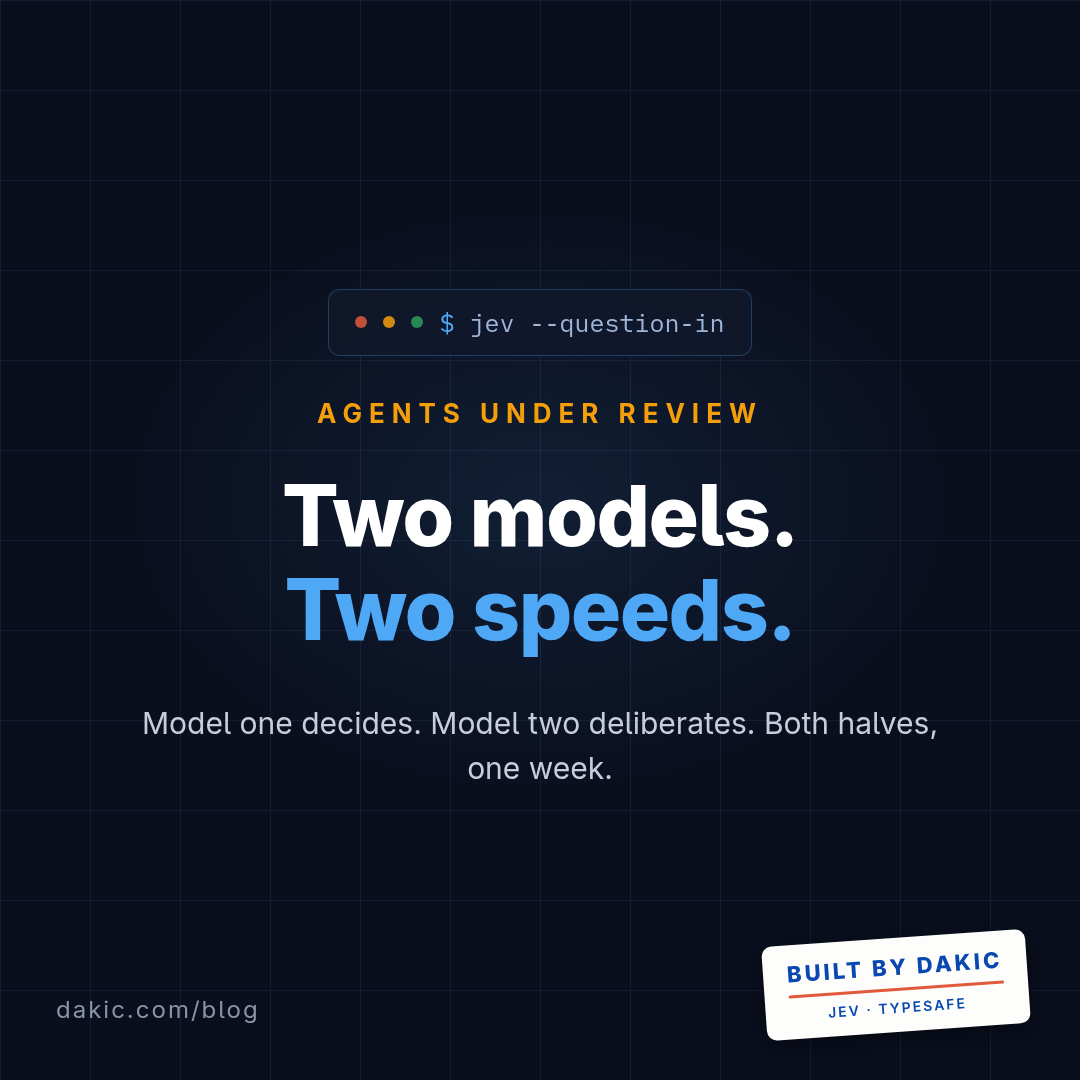
The Other Half of Agentic Thinking
The missing piece of agentic work was never a better writer. It was a decider. Jev, a new decision model from TypeSafe, brings speed to decision making: question in, decision out.
The point
Practical Futurism is not a long discovery phase or a slide deck about transformation. It is a working process for turning uncertainty into useful software.
We look for the constraint, test the path forward, ship the useful parts, and improve the system around the work. The goal is not only to deliver features. The goal is to make the product, workflow, and codebase easier to change.
Each cycle should produce working software and sharper judgment about what to do next.
Find the Constraint
We identify what is slowing the product down: architecture, workflow, unclear scope, technical debt, tooling, or risk. The first job is to find the real bottleneck.
Prototype the Path Forward
We test ideas quickly before committing to a large build. Prototypes make trade-offs visible and show what is practical now.
Ship the Useful Parts
Validated work moves into production through weekly Momentum Sprints. You see visible progress through commits, deploys, screenshots, and decisions.
Simplify the System
In the process, we create clearer procedures, simpler workflows, and codebases that are easier to change. Complexity that does not help the work gets removed.

Working rhythm
The cadence stays lightweight so the work stays visible. You should always know what changed, what matters next, and where a decision is needed.
Focused build cycles. You see progress through commits, deploys, screenshots, notes, and direct questions. Feedback happens close to the work instead of waiting for a ceremony.
We review what shipped, what we learned, and what should happen next. The following week starts with a clearer system and sharper priorities.
The outcome
A useful engagement should leave you with more than shipped features. It should leave behind a product team that can move with less friction.
Prototypes expose the trade-offs early, so the next move is based on working evidence instead of guesswork.
Procedures and handoffs get simplified while the work is happening, not after another process meeting.
The codebase becomes easier to extend, safer to adjust, and more ready for the next product decision.
Can we help?
Tell us about your idea — we’ll figure out how to help, one step at a time.

Practical notes on shipping daily, using prototypes well, improving codebases, and keeping product work moving.
The missing piece of agentic work was never a better writer. It was a decider. Jev, a new decision model from TypeSafe, brings speed to decision making: question in, decision out.
A practical weekly loop for turning a backlog into a useful decision, a small proof, evidence, and a clearer next move.
A practical method for making an existing codebase easier to change: name one painful change, clear only its path, and let the finished change justify the cleanup.

I use AI throughout product development, but volume does not prove value, so I am measuring where it helps, where I intervene, and where work gets repeated.