
Explore First. Decide Later.
Workomator gives unfinished product thinking a place to develop before a team turns it into a roadmap item, specification, or task.
- Project
- Workomator
- Role
- Product strategy, workflow design, and engineering
- Timeframe
- 2026 – present
- Status
- Live
Evidence from the work
- Artifact
- Working product
- Product model
- Separate Explore and Decide modes
What this is
Workomator is a product-direction workspace for founders and small teams. It connects early observations, open questions, decisions, specifications, and delivery work without requiring each thought to arrive in a finished form.
The product remains in active development. Its information architecture makes the central decision visible: Explore and Decide are separate modes.
The friction
Teams often capture an early idea inside a system designed for committed work. A half-formed customer signal becomes a backlog item. Someone adds an estimate and an owner. The interface makes the idea look settled before the team has examined the problem.
Notes and conversations preserve uncertainty but often lose the path to implementation. When the team returns to an idea, its reasoning may be scattered across documents and chat threads.
AI coding agents increase the cost of vague direction. They can produce a large implementation from a requirement that the team never finished thinking through.
The senior decision
We gave exploration and commitment different homes.
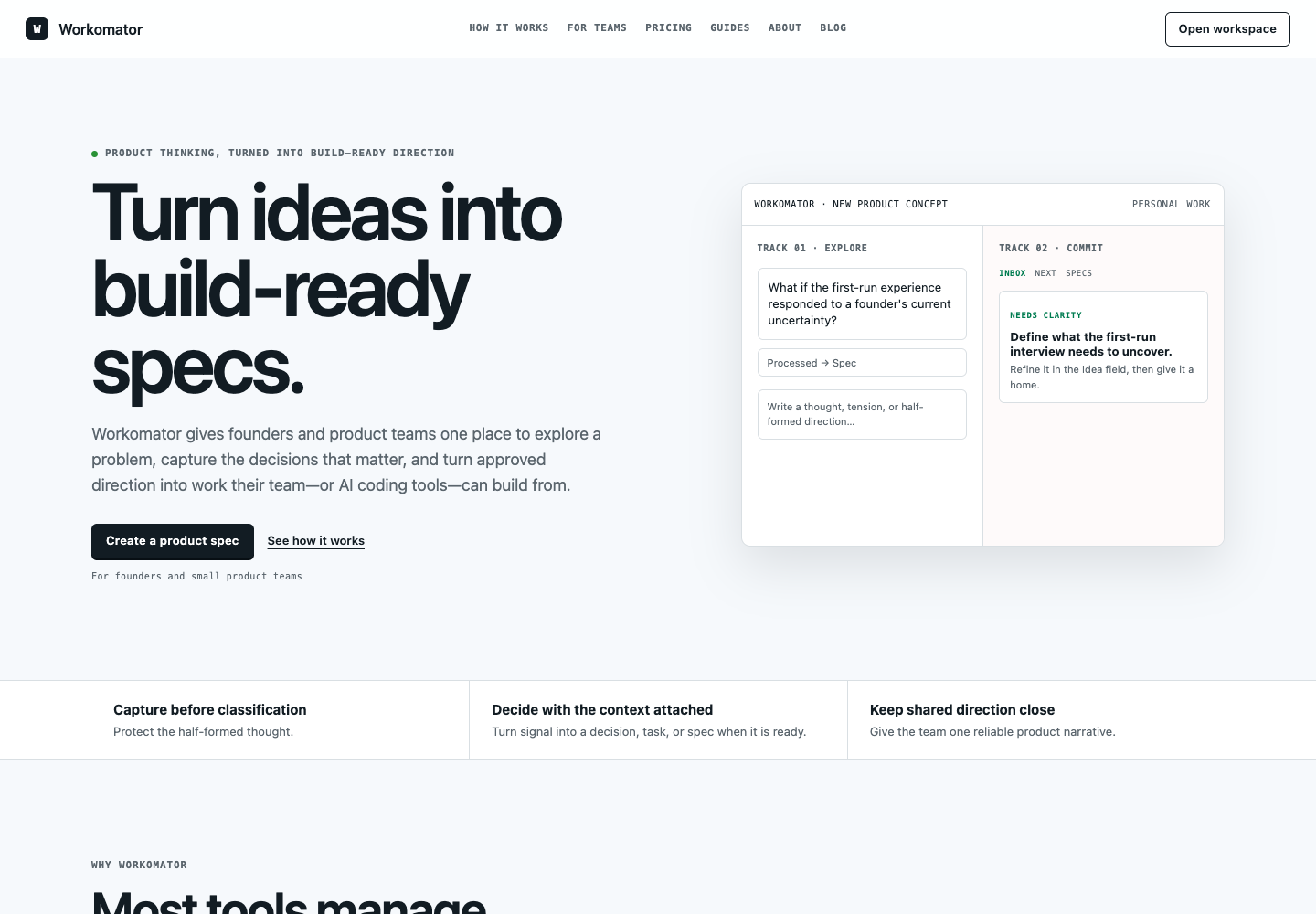
Explore accepts tensions, customer signals, questions, and rough ideas without forcing a type or delivery date. Decide adds the structure required for action: a product decision, task, specification, owner, or roadmap horizon.
The separation gives unfinished thinking room without detaching it from delivery. A team can promote an explored idea once the reasoning supports a commitment, and the workspace preserves the path between those states.
This model also gives coding agents a cleaner contract. Approved direction can move into delivery systems while open questions remain outside the implementation queue.
What became real
Workomator now provides distinct Explore and Decide workflows, shared projects, Now/Next/Later planning, and a place for product narrative and specifications. The workspace connects product intent to delivery work while preserving the reasoning behind a decision.
Evidence
The working product is available at workomator.com. The interface shows the Explore and Decide model and the path from early thinking to structured product direction.
The implemented workflow is the current proof. We need use over time before making claims about planning speed or delivery performance.
What we learned
Teams should add structure after they have earned it. Applying roadmap fields to every observation creates false certainty and encourages premature implementation.
AI agents make this boundary more important. Clear product intent gives an agent useful constraints. Unresolved thinking belongs in a space where a person can challenge it before code gives it weight.
Current state
The core Explore and Decide model is live. We continue to refine how decisions connect to specifications, delivery tools, and implementation feedback.